 Death in the Andes
by Mario Vargas Llosa, Edith Grossman (Translator)
Death in the Andes
by Mario Vargas Llosa, Edith Grossman (Translator)
From Booklist , February 1, 1999 Alternating points of view give meaningful structure to a disturbing new novel by Vargas Llosa, the great Peruvian writer. Guerrillas, army officers, environmentalists, a bizarre witch and her equally strange husband, and even a couple of French tourists all have their roles to play as the author fashions a plot centering on the mysterious killing of three men in a remote village. Finding the killer is the framework upon which the author develops a pageant of contemporary Peruvian society, a violent environment where even baby vicunas are not exempt from needless slaughter. For North American readers, Vargas Llosa's novel puts faces on, supplies reasons and motives behind, and imparts a history of the terrorism that has plagued Peru in recent years--a situation most of us see only as an inconvenience to traveling there. This pungent work of fiction imparts the real picture, a moving depiction of the strengths and weaknesses in the fabric of Andean culture. Brad Hooper Copyright© 1996, American Library Association. All rights reserved --This text refers to an out of print or unavailable edition of this title. 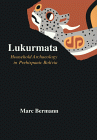 Lukurmata : Household Archaeology in Prehispanic Bolivia
by Marc Bermann
Lukurmata : Household Archaeology in Prehispanic Bolivia
by Marc Bermann
Book Description: Household archaeology, together with community and regional settlement information, forms the basis for a unique local perspective of Andean prehistory in this study of the evolution of the site of Lukurmata, a pre-Columbian community in highland Bolivia. First established nearly two thousand years ago, Lukurmata grew to be a major ceremonial center in the Tiwanaku state, a polity that dominated the south-central Andes from a.d. 400 to 1200. After the Tiwanaku state collapsed, Lukurmata rapidly declined, becoming once again a small village. In his analysis of a 1300-year-long sequence of house remains at Lukurmata, Marc Bermann traces patterns and changes in the organization of domestic life, household ritual, ties to other communities, and mortuary activities, as well as household adaptations to overarching political and economic trends. Prehistorians have long studied the processes of Andean state formation, expansion, and decline at the regional level, notes Bermann. But only now are we beginning to understand how these changes affected the lives of the residents at individual settlements. Presenting a "view from below" of Andean prehistory based on a remarkably extensive data set, Lukurmata is a rare case study of how prehispanic polities can be understood in new ways if prehistorians integrate the different lines of evidence available to them. Household archaeology, together with community and regional settlement information, forms the basis for a unique local perspective of Andean prehistory in this study of the evolution of the site of Lukurmata, a pre-Columbian community in highland Bolivia. First established nearly two thousand years ago, Lukurmata grew to be a major ceremonial center in the Tiwanaku state, a polity that dominated the south-central Andes from a.d. 400 to 1200. After the Tiwanaku state collapsed, Lukurmata rapidly declined, becoming once again a small village. In his analysis of a 1300-year-long sequence of house remains at Lukurmata, Marc Bermann traces patterns and changes in the organization of domestic life, household ritual, ties to other communities, and mortuary activities, as well as household adaptations to overarching political and economic trends. Prehistorians have long studied the processes of Andean state formation, expansion, and decline at the regional level, notes Bermann. But only now are we beginning to understand how these changes affected the lives of the residents at individual settlements. Presenting a "view from below" of Andean prehistory based on a remarkably extensive data set, Lukurmata is a rare case study of how prehispanic polities can be understood in new ways if prehistorians integrate the different lines of evidence available to them. 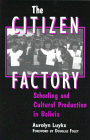 The Citizen Factory : Schooling and Cultural Production in Bolivia (Suny
Series, Power, Social Identity and Education)
by Aurolyn Luykx, Douglas Foley
The Citizen Factory : Schooling and Cultural Production in Bolivia (Suny
Series, Power, Social Identity and Education)
by Aurolyn Luykx, Douglas Foley
Editorial Reviews : This vivid ethnography of Bolivian students explores the challenges they confront as they try to maintain their indigenous identity. In examining how the concrete practices of schooling shape student identities, this book looks at how the discourses and texts produced by students themselves are appropriated toward this end, and how students mobilize their own cultural resources to contest this process, critiquing and subtly transforming the agenda of state-run education. These issues are addressed as they are played out in the lives of young Native South Americans (Aymaras) studying to become rural schoolteachers in Bolivia, the poorest and most "indigenous" of all Latin American countries. It is a vivid ethnographic account of how these students confront the assaults which their professional training wages against their indigenous identity, as they alternately absorb and contest the ethnic, class, and gender images meant to transform them from "Aymara Indians" into "Bolivian citizens." 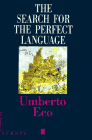 The Search for the Perfect Language (The Making of Europe)
by Umberto Eco, James Fentress (Translator)
The Search for the Perfect Language (The Making of Europe)
by Umberto Eco, James Fentress (Translator)
Editorial Reviews Synopsis The idea that there once existed a language which perfectly and unambiguously expressed the essence of all possible things and concepts has occupied the minds of philosophers, theologians, mystics, and others for at least two millennia. This book offers an investigation into the history of that idea and of its profound influence on European thought, culture, and history. 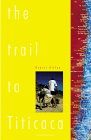 The trail to Titicaca: A journey through Southamerica
By Rupert Attlee
The trail to Titicaca: A journey through Southamerica
By Rupert Attlee
Book Description : A trio of inexperienced cyclists set out to cross South America to aid the Leukemia Research Foundation.  From Viracocha to the Virgin de Copacabana
by Verónica Salles-Reese
From Viracocha to the Virgin de Copacabana
by Verónica Salles-Reese
 Insight Guides South America
by Insight Guides (Editor)
Insight Guides South America
by Insight Guides (Editor)
|