


|
|
|
|
Jorge Pedraza Arpasi
 Aymara is a language spoken by aproximately 1.600.000 persons around the
Titicaca lake. More precisely, according the last censuses of both Bolivia
(1992) and Chile (1992) and Perú (1993) there are 1.237.658 Bolivian Aymara
speakers, 296.465 Peruvian speakers and 48.477 Chilean ones. All these
speakers conform the Aymara people. In the province of Tupe/Yauyos, at 300
Km southeast of Lima city, are the last 600 speakers of Jaqaru which,
in accordance to M.J. Hardman, is a familiar but separate language from
Aymara. However, in accordance to other language classification catalogues,
Jaqaru is only a dialectal variation from Aymara. The existence of Jaqaru is
an indicator that in ancient times Aymara language spread wide areas of the
present Peru, Bolivia, Chile and Argentina, far away from the Titicaca
plateau. Examples of these areas are inside the present Perú, at Arequipa
provinces (the Collaguas), at Apurimac provinces (the Aymaraes), at Cuzco
provinces(the Canchis and the Canas), at Puno northeast provinces(Pucara,
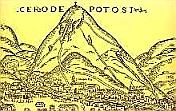
Putina, Ayaviri). Inside present Bolivia, at Potosí, Cochabamba, and Oruro,
Chuquisaca. In the north of Argentina(Humahuaca) and all the north of
Chile(Chuquicamata, Calama, Arica, Tarapaca).
Aymara is a language spoken by aproximately 1.600.000 persons around the
Titicaca lake. More precisely, according the last censuses of both Bolivia
(1992) and Chile (1992) and Perú (1993) there are 1.237.658 Bolivian Aymara
speakers, 296.465 Peruvian speakers and 48.477 Chilean ones. All these
speakers conform the Aymara people. In the province of Tupe/Yauyos, at 300
Km southeast of Lima city, are the last 600 speakers of Jaqaru which,
in accordance to M.J. Hardman, is a familiar but separate language from
Aymara. However, in accordance to other language classification catalogues,
Jaqaru is only a dialectal variation from Aymara. The existence of Jaqaru is
an indicator that in ancient times Aymara language spread wide areas of the
present Peru, Bolivia, Chile and Argentina, far away from the Titicaca
plateau. Examples of these areas are inside the present Perú, at Arequipa
provinces (the Collaguas), at Apurimac provinces (the Aymaraes), at Cuzco
provinces(the Canchis and the Canas), at Puno northeast provinces(Pucara,
Putina, Ayaviri). Inside present Bolivia, at Potosí, Cochabamba, and Oruro,
Chuquisaca. In the north of Argentina(Humahuaca) and all the north of
Chile(Chuquicamata, Calama, Arica, Tarapaca).
Until 1970 there were over two million of speakers of Aymara, therefore the decreasing rate of speakers, in little more than 20 years, was over 20%. The main reasons for this are: 1) The poorness of Peruvian and Bolivian States, which are unable to offer an adequate Spanish/Aymara bililingual education to their native speaker childrens. 2) The low prestigie of Aymara, especially in the urban centers. This forces to native Aymara speakers to learn Spanish and hide its mothern tongue.
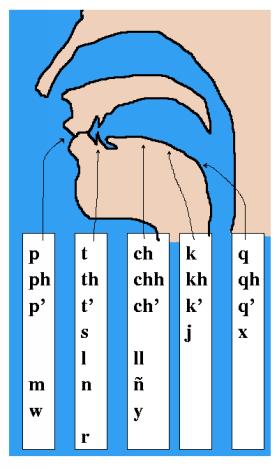
Aymara language has a good official alphabet called "único" released via
the law DS 20227 (1984/09/05) by the Bolivian government. Also it was
recognized via the law RM 1218 (1985/18/11) by the Peruvian government.
This alphabet has 26 consonants y 3 vowels.
Aymara language is an agglutinating system of roots(verbs, nouns, adverbs)
and suffixes. It
has been shown that it has more than 200 suffixes. By composing
adequately the verbal roots and suffixes M.J. Hardman had estimated that
there are more than 363.394.720 verbal forms. A single example of such
construction: consider the verbal root aruña(=to speak) and 14
suffixes, then by combing them is obtained the word
aruskipasipxañanakasakipunirakïspawa(=It is my personal knowledge
that it is necessary for all of us, including you, to make the effort to
communicate).
 Ethnically the Aymara people are from the same group who
populated all the Americas since 12000 BC and who are mostly known as
indians. There are strong and deep ties between the Titicaca lake and
the Aymara people. Such ties begin with the name titicaca which comes
from to Aymara words titi(=cat), and qaqa(=grey colour), that
is, titicaca means "the grey cat". The Titicaca plateau is over 12.000 feet
above the sea level, therefore it should have a non-living climate, but the
waters of the lake warm all the region allowing to live millions of persons.
Pedro Cieza de Leon tell us that this plateu was the most populated territory
of the entire Inca Empire.
Ethnically the Aymara people are from the same group who
populated all the Americas since 12000 BC and who are mostly known as
indians. There are strong and deep ties between the Titicaca lake and
the Aymara people. Such ties begin with the name titicaca which comes
from to Aymara words titi(=cat), and qaqa(=grey colour), that
is, titicaca means "the grey cat". The Titicaca plateau is over 12.000 feet
above the sea level, therefore it should have a non-living climate, but the
waters of the lake warm all the region allowing to live millions of persons.
Pedro Cieza de Leon tell us that this plateu was the most populated territory
of the entire Inca Empire.
The language of Tiwanaku is still a controversial issue. In the XIX century the frenchmen Castelnau and others proposed that the builders of Tiwanaku were from a dissapeared race, probably from Egypt, and the present Aymara "imbecilic race" had not any chance to be descendants of these skilled builders. On the other hand Arthur Posnansky asserted that Tiwanaku was the cradle of the american man. For him the builders of Tiwanaku migrate to other places of all the americas engendering all the pre-Columbian cultures of the Americas. Although this, Posnasky gave not any credit to the present indians inhabitating the Titicaca plateu as descendants of the builders of Tiwanaku. Recently the archaeologist/anthropogist Alan Kolata is proposing a new theory based on new excavations and the experimentation of the "field raised" agricultural method. According to this theory Tiwanaku was a multilingual state with Aymara, Pukina and Uru/Chipaya living together in a harmonic way. 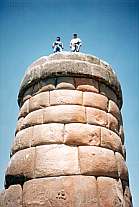 After Tiwanaku, the most important Aymara societies with independent political
organizations were the Lupaqas, the Collas(Qullas), the Paqajes, the Carangas,
the Canas, the Canchis, and the Charcas.
Among the Aymara states, it seems that the Collas were the first to either
contact or resist the Inca expansion. The Incas after conquering this region
and the south called such territory as Collasuyo (Qullasuyu). Cieza de Leon
followed such a denomination, that is, for him Colla meant Aymara people and
the Titicaca region. Today, Colla is equivalent to Aymara.
After Tiwanaku, the most important Aymara societies with independent political
organizations were the Lupaqas, the Collas(Qullas), the Paqajes, the Carangas,
the Canas, the Canchis, and the Charcas.
Among the Aymara states, it seems that the Collas were the first to either
contact or resist the Inca expansion. The Incas after conquering this region
and the south called such territory as Collasuyo (Qullasuyu). Cieza de Leon
followed such a denomination, that is, for him Colla meant Aymara people and
the Titicaca region. Today, Colla is equivalent to Aymara.
The conquest of the Aymara states by the Inca empire, also, has not an accurate version. One hand of historians say that the Inca empire attached the Aymara people in a pacific and respectfull way and the empire learned and took the Aymara culture as the Romans took the Greek culture. On the other hand some other historians theorize that the conquest of the Aymara states were after bloody wars and under the Inca dominance there were many uprisings. Whatever the right version on the Inca's dominance, for a some reason the Incas did not were able to impose the imperial Quechua language over the Aymara language, at least not around the Titicaca lake. Only under the Spanish domain began the penetration of the Quechua language by the North side. However, nowadays the Titicaca plateu still have Aymara sepakers majority.
Immediatly after the last battle of the independence war in 1824, the entire
territory where live the Aymara people was inside the Peruvian Republic. One
year later, in 1825, the Alto Peru region separates from Peru becoming the
Republic of Bolivia. Such separation broke the Titicaca plateau and hence the
Aymara people in two chunks, each one belonging to two different countries.
Years later, in 1879 broke out the war of Chile against both Bolivia and Peru.
Chile won the war and hence it conquered some Aymara regions from Bolivia and
Peru. In this way, nowadays the Aymara people are divided into three countries.
 It is comprehensible that
along with the bumps of the political Aymara structures, the Aymara culture
underwent in its sequenciality with advance and backward movements. One of the
highest points of the development of the Aymara culture was forced by the,
almost, 12.000 feet above sea level of the Titicaca plateau. This altitude was
(and still is) a limitation for the maize's grow that was the nourishing base
of almost all the towns of pre-Columbian America. It is very likely that
ancient Aymaras solved this
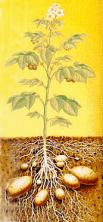
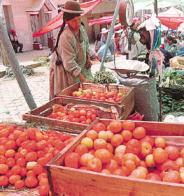
nutritional problem obtaining the potato crop from a wild variety
which, still today, can be found in almost any place of the Titicaca plateau
during the austral summer months and which is well known as qamaqi
ch'uqi(fox's potato). When the Spaniards conquered the Inca empire found
the potato in all the places of the Tahuantinsuyo, but they perceived that the
intensive variation was only given in the Titicaca plateau where there were
more than 200 varieties of this tubercle. The potato was relegated, it was not
accepted, as eatable during two centuries in Europe until the Irish, without
having no other nourishing option began to cultivate it and later depending
exclusively on the potato. Such dependency reaches dramatic levels when
appears a plague to destroy whole harvests which causes the famous Irish
famine. The later welcome and world-wide acceptance of potato as food of
first order allows to affirm that the legacy of the potato is the main
contribution to humanity of the ancient Aymara culture .
It is comprehensible that
along with the bumps of the political Aymara structures, the Aymara culture
underwent in its sequenciality with advance and backward movements. One of the
highest points of the development of the Aymara culture was forced by the,
almost, 12.000 feet above sea level of the Titicaca plateau. This altitude was
(and still is) a limitation for the maize's grow that was the nourishing base
of almost all the towns of pre-Columbian America. It is very likely that
ancient Aymaras solved this
nutritional problem obtaining the potato crop from a wild variety
which, still today, can be found in almost any place of the Titicaca plateau
during the austral summer months and which is well known as qamaqi
ch'uqi(fox's potato). When the Spaniards conquered the Inca empire found
the potato in all the places of the Tahuantinsuyo, but they perceived that the
intensive variation was only given in the Titicaca plateau where there were
more than 200 varieties of this tubercle. The potato was relegated, it was not
accepted, as eatable during two centuries in Europe until the Irish, without
having no other nourishing option began to cultivate it and later depending
exclusively on the potato. Such dependency reaches dramatic levels when
appears a plague to destroy whole harvests which causes the famous Irish
famine. The later welcome and world-wide acceptance of potato as food of
first order allows to affirm that the legacy of the potato is the main
contribution to humanity of the ancient Aymara culture .
Also, the ancient Aymaras pionnered the dehydratation processes of the potato. This dried potato is known as ch'uñu(chuño) and it is made so for storage purpose. Until now the ch'uñu is still widely produced as store food among the Aymara people. Basicaly, the dehydratation technique, is the two weeks-long alternant exposure of the potato to the both burning sun of the days and freeze nights of the Titicaca plateau.
There are many dances with aymara origin. This diversity has turned to Oruro and Puno as the folkloric capitals of Bolivia and Peru, respectively. Native dances and mestizo dances are classified in two groups. The origins of the native dances go back to times previous to the Spanish conquest, therefore they have few elements of European origin. Unfortunately, these dances have few acceptance in the Altiplano cities, solely being practiced by countryside native people. Examples of these dances: Chaqallus, Lawa K'umus, Chuqilas, K'usillos, etc. On the other hand the mestizo dances are the ones with later origin to the Spanish conquest. Thus, they have European and native elements in a balanced way. At the times of celebrations, specially catholic, widely they are accepted and executed in the urban centers of the plateau of the Titicaca. Its suits, called traje de luces(suit of lights), for the similarity of the suits of the Spanish bullfigthers, are richly ornamented by false gem stones causing that his acquiring/rent be expensive. Examples of these dances: diablada, caporal, morenada, etc.
Ancient Religiosity[Pre-Christian](?-1550)The distinct aymara towns of the antiquity have had different local God and thus various forms of religiosity. However, these local varieties were based on the two pillars of the Pan-Andean religiosity as are: the agricultural religiosity and the worship to the ancestors (deads).
The local Gods are the hills and the mountains regarded as guardians and protectors (Awkis, Achachilas). This form of spirituality continues in force until nowadays in which each local hill has a name and is always invoked like the local guardian. The Devils were believed from the underground and were known by either Anchanchu or Saxra. Other small Gods reside in the water fountain ( Phuju). Another important aspect related to the Aymara spirituality is the ritual and natural medicine whose practice is carried out by the yatiri (wise). The yatiris with the greater prestige and efficacy since ancient times, until the present century XXI, are from the town Kallawaya in the mountain range of the Charazani in Bolivia. Modern Religiosity[Cristiana](1550-nowadays)The Spaniard ecclesiastical and political authorities tried, without success, the destruccion of the native religiosity of the Aymara people. They destroyed the icons, the chullpas, etc. It is very sad to review the brutal way in which was imposed the new religion. But the strengths of the nature, the hills, the lakes, the ground keeped the same, maintainnig secretly, the religious tradition of the Aymaras. However, it is just to indicate that there were many voices, to the interior of the Catholic Church, that were opposed to this wrong form of "evangelization". Inside these moderated branchs of the Church were the religious orders of the jesuitas and fransicanos that chose the cristianization or accommodation of the old Aymara Gods. In this way the powerful God Thunupa is transformed into Apu Qullana Awki, useful identification for religious end of explanation of the creation of the world. However, an important characteristic of the God Thunupa was its identification with the lightnings and thunders; thus Thunupa can be simultaneously Apu Qullana Awki (creator of the world) and St. Bartholomew; (the master of the lightenings). Another important syncretic accommodation is the identification of the Pachamama with Virgin Mary. This mix is reflected in the customs (fiestas patronales), in the art of the century XVIII (Schools Cuzqueña and Potosina of Painting) called of mestizo baroque. An another example of this syncretism is the sanctuary of Our Lady of Copacabana; at the shores of the lake Titicaca and natural port toward the island of the sun; Quta Qhawaña, already was sacred before the arrival of Christianism.During the first and intolerant years of the present Andean republics this syncretism was practiced in a secret way. Since the second half of the century XX this syncretism is practiced openly, in some cases with the with the recognition of the Catholic Church. The Protestant(evangelical) churches continue intolerant, prohibiting the practice of the ritual and traditional medicine. This has made arise an enormous discussion, because it is known that this traditional medicine has positive practical results, specially with the renowmed Kallawayas. A yatiri converted is prohibited, for some protestant churches, to practice his curative knowledge. By another side, The Aymara ritual of the ch' alla which is the gratitude to the ground (Pachamama) is peacefully allowed together the catholic fiestas patronales. An interesting aspect of this syncretism is that the most important festivity of the Christianity as is the Christmas, never had that caracter of importance among the Christian rural Aymaras. For the Aymara peasant is a great deal more important the festivity of carnivals (mara anata), epoch of flourishment of the fields of work and therefore favorable epoch to perform the ch' alla so that the flowers become good fruits. It is clear that in the last years with the masive imigration of the Aymaras to the the urban centers, it is estimated in a 70-80%, the little lights (from Taiwan) of Christmas, the masks of St. Clauss have done that these urban Aymaras assimilate this festivity, but in this case their celebration is not distinguible of the others non Aymaras, for which, lacks any sense to speak of a Christmas tradition of the Aymara, as some ones think can exist. |
| AYMARA UTA |
|---|

 Each Aymara word has an unique stressed syllable. Normally this stress is
next to last syllable. However the contracted words, with loss of the last
vowel, may have the stress on the last syllable. For instance
Walikiwa(=O.K.) by contraction becomes Walikiw.
Since the readers interested on Aymara books are few, the publications
are very limited. However, there are non government efforts from
organizations which are publishing in Aymara. Examples of such organizations
are RADIO SAN GABRIEL of La Paz, CENTRO MARKA of Cochabamba and Instituto de
Lengua y Cultura Aymara - ILCA at La Paz.
Each Aymara word has an unique stressed syllable. Normally this stress is
next to last syllable. However the contracted words, with loss of the last
vowel, may have the stress on the last syllable. For instance
Walikiwa(=O.K.) by contraction becomes Walikiw.
Since the readers interested on Aymara books are few, the publications
are very limited. However, there are non government efforts from
organizations which are publishing in Aymara. Examples of such organizations
are RADIO SAN GABRIEL of La Paz, CENTRO MARKA of Cochabamba and Instituto de
Lengua y Cultura Aymara - ILCA at La Paz.
 The conquest of the enormous Inca empire began when a bunch of
one hundred and half Spaniards, suposedly attending a party invitation of the
Inca emperor, deceived and took him as hostage. Such a situation was a
completely new one because in the theocratic Inca state its emperor was
believed as a god. The astonished Inca army was unable to have a quick
reaction to face such a crucial circumstance.
Meanwhile these few Spaniards were able to do alliances with
some native nations conquered before by the Incas. These nations
saw the Spaniards as the warlords to lead them to its independence from the
Incas. After murdering the Inca emperor, the Spaniards, allied with
thousands of native fighters, especially from the Cañaris and the
Wankas, were invincible in the decisive battles. A few years
after the comsummation of the conquest, much of these native allied
were very repentant from its fatal mistake, but was too late.
The conquest of the enormous Inca empire began when a bunch of
one hundred and half Spaniards, suposedly attending a party invitation of the
Inca emperor, deceived and took him as hostage. Such a situation was a
completely new one because in the theocratic Inca state its emperor was
believed as a god. The astonished Inca army was unable to have a quick
reaction to face such a crucial circumstance.
Meanwhile these few Spaniards were able to do alliances with
some native nations conquered before by the Incas. These nations
saw the Spaniards as the warlords to lead them to its independence from the
Incas. After murdering the Inca emperor, the Spaniards, allied with
thousands of native fighters, especially from the Cañaris and the
Wankas, were invincible in the decisive battles. A few years
after the comsummation of the conquest, much of these native allied
were very repentant from its fatal mistake, but was too late.
 With the arise of the new republics the supossed enhancement
of the Aymara and other native people was not real. Furthermore, some
historians think that it was worse than the Spanish colonial times. Until the
first half of the XX century; the pongos, almost slave indian servants,
were very common into the houses of rich white hacendados.
Nowadays, the new native Aymara speakers mostly born in remote regions and
for the improvement of their lives they are forced to go to the urban
centers where, soon they feel silly because their Aymara origin.
With the arise of the new republics the supossed enhancement
of the Aymara and other native people was not real. Furthermore, some
historians think that it was worse than the Spanish colonial times. Until the
first half of the XX century; the pongos, almost slave indian servants,
were very common into the houses of rich white hacendados.
Nowadays, the new native Aymara speakers mostly born in remote regions and
for the improvement of their lives they are forced to go to the urban
centers where, soon they feel silly because their Aymara origin.
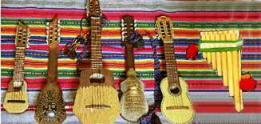 The Aymara music and dance are one of the most significant fundamentals for
the so called andean music and danzas folkloricas which now is
widely accepted and practiced. Because of
the discrimination of the indians, the Aymara musical instrument siqu
(zampoña) and other andean instruments as the charango(khirkhinchu),
quena, were performed only by the native people(indians).
But the western wave of the rebellious youth of the sixties extends to
Latin America and in Chile this youthful revolt is pronounced using musical
instruments of the indians. Thus, in the 2nd half of the sixties it was
born the then called, nueva canción or música protesta which was music
composed and executed by Chilean students using Andean instruments.
Such music had a message of left party-political-ideological content.
The Aymara music and dance are one of the most significant fundamentals for
the so called andean music and danzas folkloricas which now is
widely accepted and practiced. Because of
the discrimination of the indians, the Aymara musical instrument siqu
(zampoña) and other andean instruments as the charango(khirkhinchu),
quena, were performed only by the native people(indians).
But the western wave of the rebellious youth of the sixties extends to
Latin America and in Chile this youthful revolt is pronounced using musical
instruments of the indians. Thus, in the 2nd half of the sixties it was
born the then called, nueva canción or música protesta which was music
composed and executed by Chilean students using Andean instruments.
Such music had a message of left party-political-ideological content.
 The flourishing Latin-American dictatorships of 70's and 80's did
whereupon the Latin-American youth to adopt the nueva canción
as its instrument of manifestation of their art and ideas. This gave a
prestigious aureole to this musical theme so that its commercial acceptance
was unavoidable. Other instruments were added and was a change of music
label nueva canción for the one of commercial acceptance musica
andina(andean music)as it is world-wide known in the present time.
The flourishing Latin-American dictatorships of 70's and 80's did
whereupon the Latin-American youth to adopt the nueva canción
as its instrument of manifestation of their art and ideas. This gave a
prestigious aureole to this musical theme so that its commercial acceptance
was unavoidable. Other instruments were added and was a change of music
label nueva canción for the one of commercial acceptance musica
andina(andean music)as it is world-wide known in the present time.
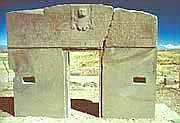
 The ancient Aymara God Thunupa who is the central icon of the
stone sculpture of the gateway of the sun, in Tiwanaku, personifies
various agents of the nature as the sun, wind, rain, hail; that can influence,
for well or for badly, the agricultural production. An another aspect of this
agricultural religion was (it is still) the Godess
Pachamama (the mother Ground), the producer of the foods.
This Goddess/Mother requires sacrifices being her favorite the fetus of
the llama.
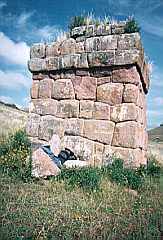
On the other hand the worship to the ancestors (cult to deads)
was manifested in a material way in the construction of
tomb-shrines whose complexity was in agreement the importance of the
deceased. The chullpas of Sillustani and Kutimbo, in Puno, are a
vestigius of this spiritual character of the Aymara people.
The ancient Aymara God Thunupa who is the central icon of the
stone sculpture of the gateway of the sun, in Tiwanaku, personifies
various agents of the nature as the sun, wind, rain, hail; that can influence,
for well or for badly, the agricultural production. An another aspect of this
agricultural religion was (it is still) the Godess
Pachamama (the mother Ground), the producer of the foods.
This Goddess/Mother requires sacrifices being her favorite the fetus of
the llama.
On the other hand the worship to the ancestors (cult to deads)
was manifested in a material way in the construction of
tomb-shrines whose complexity was in agreement the importance of the
deceased. The chullpas of Sillustani and Kutimbo, in Puno, are a
vestigius of this spiritual character of the Aymara people.